Showing posts with label Puzzle Game. Show all posts

Tuesday, 17 September 2019

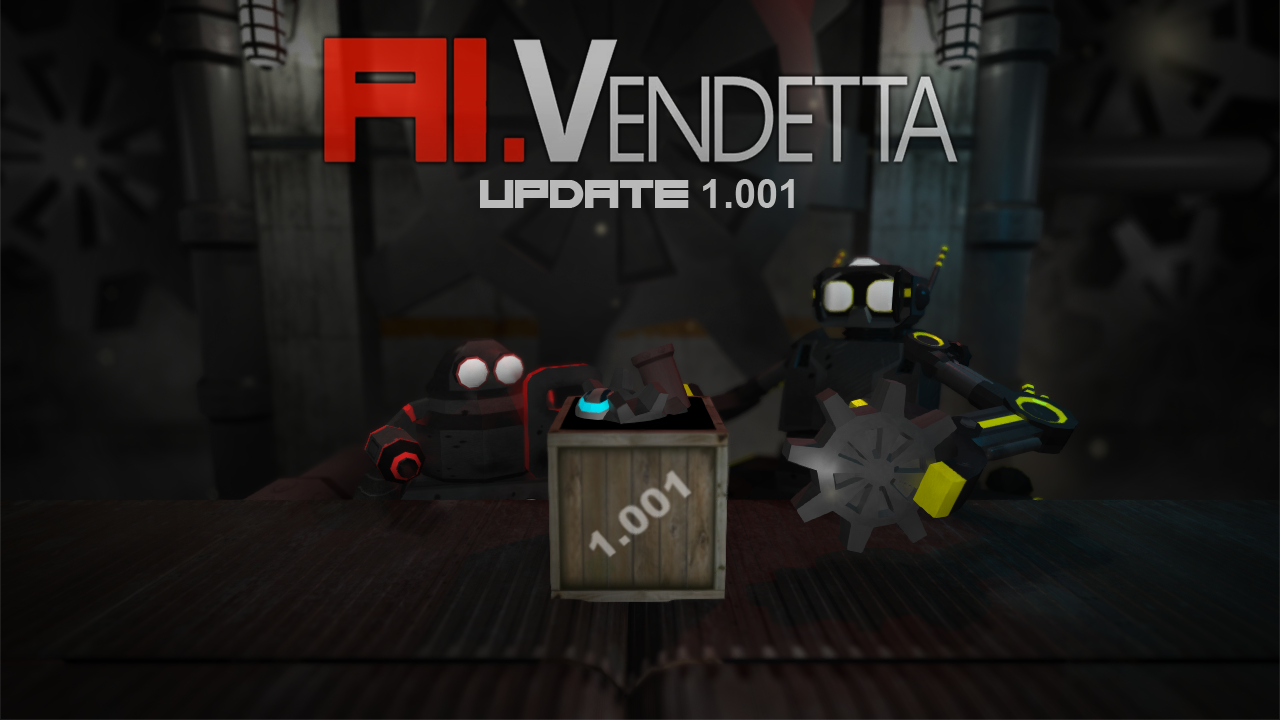
Update 1.001 is now live!

Just two weeks ago AI Vendetta launched after several years of development. The run up to the release and the time after have been really exciting for us as we hope you have been (or will be) enjoying the game. We have of course also been playing the game and have been tinkering and tweaking it ever since. That is why today we want to announce the first update to the game to address some issues and improve the game further. Should you run into any issues or have feedback, be sure to let us know! Feel free to reach out to us here, on Steam or through our website with any questions or feedback!

Below is a list of all the changes for update 1.001, note: this list may contain spoilers! Don’t read any further if you don’t want to see spoilers for the game, but rest assured we are doing our very best to keep improving the game!


Updates 1.001:
  • Added version number to main menu page and home page.
  • Disabled controller input when Steam overlay is active.
  • Option menu items can now be unfocused by pressing B when playing with controller.
  • Controls-, Options-, Credits- and Level Select screens now exit/cancel when pressing ESC or the B button on controller.
  • Added destruction particles and sound effects for debris and protective energy shields.
  • The right trigger on controller can now be used for primary actions (shoot-, laser- & magnet ability) in addition to pressing the A button.
  • The left trigger on controller can now be used for secondary actions (long distance magnet ability) in addition to pressing the X button.
  • Proximity mine now has damage range indicator.
  • Fixed issue where a turret in level 3 of the first sector could not rotate correctly and wasn’t able to hit Proto at all angles.
  • Reduced Proto’s recovery time after using the Ground-Pound ability from 1.5 to 0.9 seconds.
  • Added dialog to level 2 of sector 3 to explain that Proto’s Ground-Pound ability can also break certain objects and can stun enemies for a short period of time.
  • The title screen now prompts to “Press any button to start” when a controller is connected, instead of “Press any key to start”
  • “Cannot transform” sound effect volume balanced.
  • Fixed “ammo depleted” sound effect not playing.
  • Fixed proximity mine explosion sound not playing.

You can also read about this update on Steam.

Wednesday, 22 November 2017

Soundtrack: Completed!


Hello Everyone!

Welcome back to a new blog about AI Vendetta, this time featuring the completion of our soundtrack! It has definitely been a long while since our previous blog but meanwhile a lot of things have happened: We’ve reached the game’s beta stage, a lot of the graphics got updated, many, MANY bugs were fixed and a lot of the levels were further polished. And now we are very pleased to announce that the soundtrack has also been finished and is available on YouTube and on our website for anyone to enjoy for free. In this blog we’ll be talking a little bit about music in games, the music in AI Vendetta and what inspired us to make it.

Of course, if you want to skip right to the music, you can find it here. And for those who haven’t yet, you can still sign up for beta testing. As soon as we take care of some technicalities we will start sending out keys which you can use to unlock the game on Steam (for free!). Be sure to tell your friends!


The sound of AI Vendetta


We’ve already covered this topic before and will therefore try to keep this blog concise. If you want you can read our full coverage about sounds and music in games and how we designed the music for AI Vendetta using this link.

The importance of sound and music


From a lot of experimenting and researching in the games industry we found that a good game experience and a sense of immersion comes from a unison of multiple factors. At the heart the design of the game; how it works, responds and transforms. Secondly the graphics, this is not just about the aesthetics of the game but also about conveying information, which should be clear and efficient. Finally there is music, but even more importantly: sound. As we mentioned before, try playing a game without music and notice how much sound ties everything together, even the things you cannot see. It generates a sense of awareness, danger, excitement and space. Try watching a horror movie without sound and suddenly it’s not so scary anymore. That is the power of sound.

Inspiration and music in AI Vendetta


For AI Vendetta we had a few themes in mind which had to be persistent throughout the game; it is a puzzle game featuring robots so we have the experimental and mechanical themes on one side, but the setting is also very moody and dark. These themes come together in the soundtrack as you’ll probably hear. One of our greatest inspirations was Portal, a game that lives and breathes the experimental, puzzle and robot themes with a post-apocalyptic twist.
Please feel free to discover the soundtrack here on our website or on YouTube.

Workflow


You may remember this from before, but we have a set workflow when it comes down to designing our audio. It all starts with the setting and story elements in the game. What kind of mood do we try to set? What is the feeling that you want the player to have? How can we improve the immersion of the player in the game and its environment?

The next thing we look for is how we can integrate our thematic choices into a song. What kind of pacing do we need to add? What the player is experiencing in the game? All of that while not overpowering the existing environmental sound(effects).

This eventually, after several iterations, leads to samples which we use to test out if it actually fits in with the game and only then do we expand them into a full sized song. In time we managed to create a soundtrack consisting of 12 songs which will hopefully empower and enrich your game experience.

The soundtrack


Without further ado, we present to you the soundtrack,
created with so much love and attention by our very own Rens van der Meijs:


You can find all of the songs on YouTube or on this webpage


We hope you enjoyed this blog as we’ll try to do more of these in the nearby future until the game officially launches. For those interested, you can subscribe for the beta using this google form. Selected candidates get the game completely free on Steam, but we do hope you’ll give us some feedback in return. ;) Please be sure to tell your friends about the game if you liked it or maybe if you just liked the music as well! Especially in this run up to the launch we can really use all the support we can get! So stay tuned for more!

To all a big thanks from the development team for sticking with us and have yourselves a good day!

~The Catbyte Team


Discover us on

Tuesday, 4 April 2017

AI Vendetta: all about the Green Lights

Hi and welcome back!

Last time we blogged about AI Vendetta, we had only just embarked on our journey to the Steam platform through Greenlight. This has been a very exciting journey and with great pleasure we can say that AI Vendetta has been successfully greenlit by the community and has been recognized by Valve as an official Steam Game. We want to thank Everyone that helped us in the process, whether you voted for us, shared or are a long time follower, your love and support made all of this possible!

With that being said, AI Vendetta is not finished just yet and we still have a long road ahead of us before we will be shipping the game out to a Steam Store page near you. As we previously mentioned most of the game is actually technically finished and all of the levels have been created in (at least) a block-out state. The part where most of our focus will lie in the coming months is tying everything together, creating a lot of artwork and filling in the levels with their final artwork and story elements and of course we will be doing a lot of quality assurance. However, even in this stage we are still open for any feedback and suggestions, so feel free to leave your thoughts below in the comments or on your preferred (social) medium.

And again, thanks so much for your support!


You may be thinking "why not get the artwork for the project started earlier?", there are actually various reasons for this. The primary one being that we value the quality of the gameplay above anything else, focussing on the technical and design aspects of the game allows us to better evaluate the gameplay and iterate on it. Secondly, as you may have seen, our team background and expertise is also stronger on those points. We do have input from external visual artists, but we also do most of the modelling/UV-ing/Texturing, etc. ourselves, it just isn't our speciality. However, you can rest assured that we will not stop working on the game and it's visual appearance until we are completely happy with it!


What can you expect from us in the near future?

* We still consider the game to be in Alpha state until everything has been tied together, but we do expect to reach Beta stage around June, for which there will be an official blog.
* We are currently working a lot on improving and expanding the artwork, about which we tweet weekly, we may also dedicate a blog to the world of AI Vendetta soon.
* Our very own Rens is creating the soundtrack for AI Vendetta, which will be available on steam next to the game itself. However, we are also making it publicly available on YouTube and we introduce a new song every now and then, so stay tuned! (Find them here)
* Previously we talked about our development process, level design, programming in C# 101, the sound and UI overhaul for AI Vendetta. We still have blogs planned for the mechanics and art of AI Vendetta, which you can expect in the future. However, should you have any questions for us, or want us to dive deeper into a certain topic, feel free to suggest and you might find just that in our next blog!


That's all for today! Thanks again to those that voted and shared for us on Greenlight, your support means the world to us! Again, feel free to leave any questions, feedback, suggestions or remarks below in the comments, your preferred social media or send us an email! We consider any feedback we get and will try to answer them as quick and correct as possible!


Thanks for reading!

~Thom, Catbyte Games

Tuesday, 28 February 2017

Going Green

Yes! It finally is happening, AI Vendetta is now live on Steam Greenlight!
We want to thank Everybody; Friends, family and people from all around the world for your time, support and feedback. We could not have done it without you. Yet again we rely on your voice and your support:
Please help us get our game onto the Steam Store by voting for us on Steam Greenlight using the following link:


Feel free to leave a comment or further feedback on Steam.
We will keep you posted on our progress as we go and we will of course try to answer any questions you may have!

For those that have been following us this announcement may be a little bit surprising. We've been planning for Steam Greenlight for a while now, but when Valve announced that they would be replacing Greenlight with Steam Direct, we knew we had to act fast. The reason we prefer Greenlight is that we really are interested in the voice of the community and we feel that we would lose that connection with Steam Direct. While Direct is still a completely valid decision of Valve, which we also support, we personally feel that having a real connection with our players and their feedback is more important than (nearly) guaranteed deployment on the Steam store through Direct!

Again, thank you so much! Please help us share AI Vendetta with the world by voting for us on Steam Greenlight!

~The Catbyte Team


More on Steam Direct

We appreciate that Valve is taking steps in improving their gateway to the Steam Store. Greenlight is an amazing place where lots of indie game gems exist and where everyone can have a shot at getting their creativity and hard work out there. It also gives people a voice and puts them in control of the way games are submitted to Steam. However, there are just so many games out there right now, some which are just not quite there yet and it's just too much to demand from your players to control the flood of submissions every day. So we respect Valve's choice in putting up a slightly larger barrier to allow only the games that have the right quality and funding behind them. We will definitely miss the community's voice but our only real wish is that small devs will still get their chances and opportunities in this new system.

Valve's Announcement: http://steamcommunity.com/games/593110/announcements/detail/558846854614253751

Wednesday, 22 February 2017

UI can do it! A new interface design for AI Vendetta

Hello and welcome back!

Today we have a new blog for you, all about the importance of a good UI in video games and how our UI evolved over the development of AI Vendetta. So first of, what is an UI? It is the collective interface which you present to users of your application or game, it often plays a very big role in the way users interact with the application/game and how they perceive, process and input the exchange of information. Often when we talk about games, we also talk about the HUD. The difference between these two is that the HUD, or Heads-Up Display, is typically only the information you see on screen while playing the game. Think about your health bar, score, progression, ammo, power-ups, all different kinds of stats and maybe even a minimap. While the HUD is important, it might only be a small part of the UI that you find in some games.

What makes the UI so important?

As we discussed before, the UI plays a big part in how people exchange information with the game. Especially if you consider games which rely heavily on their interface, think about the majority of (classic) role playing games. In modern games, MMORPGs typically have a very expansive interface for you to customize your character, moveset, quests, etc.

There are specialized people who design these user interfaces, but besides that they also care a lot about the User Experience (UX), because a well designed UI is both efficient in conveying information and immerses with the game's visual appearance and thematics. Some games even incorporate their UI in the game world itself, think about having your ammo counter on the weapon/tool you use in game, a health bar that is integrated into the characters armour (Deadspace) or the appearance of the UI is as if it were inside the helmet of the playable character (Metroid, Republic Commando).

So how did we design and integrate the UI for AI Vendetta?

At first we really didn't start out with an elaborate UI. We just had the main information that we needed on screen and I think a lot of indie developers probably go about it the same way. There wasn't really an overlaying menu structure either that led into the game. When you start out building a game, especially as an indie developer, you want to get a good feel for the content and gameplay value of the game so you start out with the bare basics for your UI. Over time it gets polished and touched up to make it more pleasing. But there comes a point where you really need to think about "how can we make this UI look good, make it fit with the game's art style and most importantly make everything readable while not distracting". We also needed to think about how the menu structure would work, the player must be able to do all the necessary steps, but as efficient as possible, after all, it's about playing the game, not about looking at menu screens*.

*Please note that there are games which rely more on the usage of elaborate UIs which convey a lot of information. For example strategy games and RPGs in general. AI Vendetta, as an action/puzzle platformer, doesn't really offer that much information through UI, more through environmental story telling.

So then... you end up with an UI design and/or Game Flow, it may look something like this:


After several iterations we ended up with an interface that we like, it has the right visual feeling to it and draws just the right amount of attention to it. As we are working with Unity, we also decided to upgrade from Unity's legacy UI structure, which is completely code driven, to Unity's most recent UI solution "Canvas". Canvas has been out there for a while now (since Unity 4) and has been receiving improvements ever since. The advantage of Canvas is that it really exposes the way a UI can be built to artists and designers, which are typically the people who will design the UI in the first place. Instead of having a coder rebuild their designs or creating tools that can port their designs, they can now build it directly in Unity. This makes the whole process a lot smoother and really enables artists to tweak and edit at their hearts content. There is still some coding involved, but due to the actual draw calls being abstracted away by Unity, you are really only left with the actual functional code for controlling the UI, which makes the code a lot cleaner.
So overall, Canvas does not just add some improvements over legacy, it really gives power to the right people.

So this is how our UI looks now:


This a comparison shot to see how our previous HUD looked and what it looks like now in Canvas:


That is all for now! I hope you enjoyed this post, if you want further information on our UI or general help with your Unity Canvas experience, please feel free to get in touch. Send us a message or leave a comment below if you like! We have more articles on AI Vendetta here on our website, as well as the recently released soundtrack and an alpha stage demo of the game (with the old UI unfortunately). If you have any feedback or questions for us, please let us know and we'd love to get into contact!

We also have some more exciting news coming up early next week, so please stay tuned!
Thanks for reading and hopefully till next time!

~Thom, Catbyte Games

Wednesday, 18 January 2017

The Sound of AI Vendetta

Hi!

Welcome back to another blog!
Today we would like to share a little bit about the music that makes AI Vendetta sound the way it does. And not just that, there is a bunch of sounds and effects that together make the world come alive. Because we love sharing, we put all the songs from the soundtrack (those that have been announced) here on our website for you to listen to! Of course you can also visit our YouTube channel for the soundtrack and other videos or find them here on our website using this link.


For those interested, there is also a short story on our experience with creating the soundtrack of AI Vendetta below. If you liked this article or any the work we do, please leave us a comment. You can also play the AI Vendetta alpha demo using the link in the menu bar. Of course we would love any feedback you may have on the game and we would very much like to get into contact so leave us a message or follow us on your favourite social media!


Making the sound of AI Vendetta


So how did we get to creating the soundtrack and what inspired us in the process? That can be best explained in the words of our very own Rens van der Meijs, who works on the project as programmer, but is in charge of anything music related in the project as well!
For this project we really had to sit down and define what it was that AI Vendetta is; What mood and setting do we have, what message are we trying to get across, what is the story of AI Vendetta? A lot of the immersion in a game comes from sound because besides being very visually oriented, we as humans are also tuned into hearing a response from the actions that we take and from events that happen in the world. The best sounds are often those you cannot hear or notice. They are the subtle noises that make the world come alive and sound natural. Think about footsteps, the wind, the sound of a passing car. You know they are there even though you don't always conscientiously perceive them.

With AI Vendetta we are also spending a lot time just adding sounds and effects to everything, not to make them stand out, but to make them fit in. It is really important to do this because otherwise nothing would feel real. Something really interesting to do, is to play a game and turn off the music. Just listen to all the sounds that are happening. Suddenly it becomes apparent that there is such a rich soundscape in many games, sounds that you didn't notice before but would really lack if they weren't there. A good example of this is to play an open world game such as the Witcher 3 or the Elder Scrolls: Skyrim.

The story of AI Vendetta and also the general mood is very dark and gloomy, almost desperate. But it is also a story about adventure, exploration and bravery. We also have the robotical theme going on throughout the game which needed to be present in the soundtrack. So we took a lot of inspiration from existing games and movies to get to know what feels right in which situation. For example, we really like the soundtrack of Portal 2 because it had the experimental and adventurous theming to it, but also was set in a more futuristic setting (with robots!). For us most of the time it really comes down to what message we want to get across and we try to fit the music to that specific setting, thus every song was tailor made for a specific usage and message. You may also notice that the music changes slightly throughout the game as the story progresses to better translate the underlying thematics.


The soundtrack of AIVendetta, with more to come.


If there is one thing that we want you to take away from this story, it's that music and sound effects are really important to any game experience. Don't underestimate the power of sound when it comes down to creating an immersive experience. We are very lucky to have such an amazing in-house musician to help us create the game experience that we want to bring to you and we would very much advise any gamedevs out there to invest into their game audio as well. During our process of creating AI Vendetta we also met a great musician, Ninichi, who actually creates game music on commission. So we would definitely recommend to check out her blog for some of her music as well as other gamedev interests if you are looking for someone to help you with your game audio!

That's all for now! If you'd like to know more about the game, please feel free to leave us a message or give us a shout on social media. We always love to get into contact and would certainly like to help out any other gamedevs as well!

And with that I "wave" goodbye to you all! See you next time!

~Thom, CatbyteGames

Sunday, 13 November 2016

Like a boss: AI-Vendetta fully leveled.

Hi!

Today we are very glad to announce that we finally have built all of the levels,
including ALL boss fights, that we are going to feature in the game!

With this we are getting closer to reaching a beta stage product! All that still needs to be done feature wise is an overhaul for our UI and Menu (with full controller support) and an all new unlockables system. At the same time we are also working on transforming the game visually, we can't just keep those grey boxes there!
And of course we will also be fixing and tuning the game till we think it's really great!

As you may notice, there is still a LOT to be done before we are going onto the market with our game. Until that point we would love to keep in contact with you, especially if you are interested in trying out the demo (link below) because your feedback really matters! And of course, after the launch we still like to hear from you and we will be there to make sure your game experience is the best possible.

So what can you expect from us in the near future?
For starters, we will keep up our social media presence, especially on twitter with weekly screenshots.
Major announcements such as the, to be expected, beta stage announcement will of course still be primarily done through our blog, but we will keep you posted through social media as well of course!

~The CatByte Team


Playable exclusively in one of the following browsers: Internet Explorer, Firefox, Safari & Opera.
Requires installation of the Unity Webplayer plugin.

Tuesday, 31 May 2016

Behind the scenes #2: Making the Rules


Hello!

Today we present a first mini-blog in a range of upcoming blogs to show you the second episode in the How it’s made video series: Making the Rules. Our colleague Rens is making these videos and we hope that they help give you more of an idea and insight into how we work and also show you a little of the work itself!

So what is this video about? It actually goes more in-depth on a previous topic where we discussed how we come up with features and prototype them before actually adding them to the game. To do this we make use of a feature matrix (remember it from a few blogs back? Image below the video). Using this matrix we can recombine existing features and combine them into new topics for mechanics or puzzle designs. We can also use this matrix to test out new idea proposals to see if they actually match with the existing content, of course you don’t want a new feature that completely breaks the balance of the game!


AI Vendetta Dev Video #2: Making the Rules

As you’ll see in the video, we usually start of brainstorming together to generate ideas. Our designer then further develops these in a concept and at the same time also validates them with the existing game content using the feature matrix (image below), among other tools. After the concept has been developed and an official design is made, the idea is then prototyped in a safe testing environment where it can be tested in various situations. Finally, when it has been completed and approved by all parties involved it can be polished and added to the game.
[ FEATURE MATRIX ]

This concludes our mini-blog. We hope you enjoyed the video and if you’d like to play the game for yourself, you can do so by clicking on the following LINK. Remember that the web demo is playable in Internet Explorer, Firefox, Safari and Opera after installing the Unity web plugin. Feel free to let us know your thoughts on the video and the game! We’d also love to stay in touch if you have any questions or suggestions, especially with our fellow developers from all around the world!

See you all next time!


~Thom de Moor, CatByte Games

If you are interested in following our progress, follow us on Blogger, Facebook, Twitter, YouTube and Google+ as well as our individual members on Google+, Twitter and Indie Gamer.
Sunday, 22 May 2016

How do they do it? - Programming

Hello!

Here is another dev blog in the How It's Made series! Today we are going to talk a little about Project Management as well as a little bit more in depth about programming the game AI Vendetta. We will also give you some useful tips that are not just applicable for programmers but for designers and project managers as well! This part may feel a little bit like a lecture but bear with us and you might get some useful tips out of it for your own projects! But don’t worry, we won’t go into too much detail when it comes down to the programming part!

Before we start however, I’d like to announce that a new and improved version of the AI Vendetta demo went live recently. It contains many fixes, tweaks and visual changes which we think you’ll like! And of course, we’d also love to hear what you think about it!
Remember that the game is playable in the following browsers: Internet Explorer, Firefox, Safari and Opera. The web demo will not run using Google Chrome unfortunately.


So what is this dev blog all about!?


You might just be wondering that! Well since programming is a very large subject we are going to talk a little bit about what we learned in past projects and how we are applying that to AI Vendetta. As we mentioned in previous posts, Iteration is key to development and iteration is also what drives us and me as a programmer to develop smart and flexible solutions for AI Vendetta. This allows the game to grow without increasing the complexity of the code. In the long run that allows me to better change existing features as well as add new ones. Which saves me time, a lot of bugs and other worries as well!

On the other hand, this also costs you more time to set up and stands in the way of prototyping an idea right away when you just start a project. So why do this? Well that brings me back to several valuable lessons I once learned from my teacher, mr. Dino Dini, as he explained the dynamics of a project. This is something that is really relevant to development and not just for programmers but everyone involved.

Basically, whenever you are working on a project, you are dealing with Unknowns in one way or the other. And Unknowns cause Risks for your project that can be pretty harmful, and unfortunately, you are almost guaranteed to run into them! So how can you mitigate these so that when they occur, you can at the very least minimize the damage? The key to this is to maintain Flexibility.

I know Flexibility is a very abstract term and you can apply it in many forms, some more desirable than the other. The way to maintain Flexibility in programming is through architecture, structure and abstractions (and staying away from programming (anti-)patterns, for which I can advise a few good books).

But how can you maintain Flexibility as a project manager? Well the truth to that is… it is very hard! Especially if you have limited experience. But there are some tips we can give you and likely scenarios you’ll encounter in game development.

1.    The first rule is, stay on top of your project! In game development all sorts of things will happen, so staying connected with your team and the current state is really important. We often try to do a weekly meeting so we can discuss what we did that week, how well it went and what our plans are for the next week (and the near future). This really helps so you can monitor issues before they arise and support each other with any difficulties you encounter.

2.    The second thing is to document your work. Usually when starting a project or a component of your project you’ll start off with developing a high level concept (Abstract idea). Next you process this concept into the actual design or steps that you are going to take in order to achieve that concept (Concrete). At that moment you are already breaking down your project into manageable steps, so that is a great start! As you do this, you can start identifying issues and unknowns in the concept. As a designer you are usually already doing this by creating Concept- and Design documents for your projects, so hats off to you!

As a programmer, you may want to consider writing technical documents; these are essentially the design documents for your code. And I know this is probably not the most fun thing you can think off, and to be completely honest, I don’t do this every time either! But this has certainly helped us in validating an idea or approach. Besides it also helps convey what you are trying to do to your colleagues.

A good example of this was when we decided to completely redesign how the Playable character in our game works on a technical level. As we were working longer on the game, the functionality of the player started to increase and with that the complexity of the internal workings as well! At one point we really wanted to refactor the way this system worked so we could compartmentalize all the mechanics of the player whilst also increasing the flexibility of the system. Because this was such a large procedure we decided to work it out on paper first. …A few drafts and changes later we were able to implement it smoothly into the game.


3.    As a third piece of advice, keep in mind the Scope of your project. The scope is directly related to unknowns in your project. As you work on your project, the scope always tends to increase as you may want to push features that are deemed necessary for your project to work that were not thought of initially, but projects also tend to “feature creep”.

Of course you still want to deliver the best product you possibly can, but sometimes you have to be a little bit hard on your team for the sake of the project. Projects going out of scope and out of budget are a few of the main reasons why a project may fail. Finding a good balance will keep your team happy and your project healthy!

4.    And the fourth and final piece of advice. As a project manager, especially with small teams, try to stay on the same level as your team. People often look at each other for advice and responsibility. So always maintain a problem solving state of mind and work together to avoid issues and solve problems as they occur.

5.    Bonus advice: make lists, I love making lists so you get an idea of where you are and what is still left to do. What we tend to do is make use of bug reporting tools to create a list of not only bugs but also features that we want to implement, for example when preparing a new demo. Because of the list everyone can stay up to date with the current status and personally, I love it when everything gets crossed off from the list :D


So where is that programming talk I was waiting for!?


Well, as I mentioned, programming is a BIG subject, but I hope that some of the things discussed above in some way help you with your project. It is probably all very straightforward but creating games is a big and complex process and I really admire everyone who sits through that process!

But before we start rounding off this blog, here are some technical specs about the game!
As you may know, AI Vendetta is being built in Unity3D. To do this we make use of C# as both Rens and I have a C++ background, so C# was the closest thing to our comfort zone. And as you may come to discover as well, C# is a really great programming (and scripting) language!

What I personally really like about Unity is that it is a very great and easy tool to learn, whilst still providing lots of support and possibilities for advanced users. Another great thing about Unity (and many other modern game engines) is that they are also really accessible for designers and artists. In the past I was used to creating tools and editors myself, but Unity has made it really easy to expose data to an interface. So while the programming team creates the game, they can expose the tweakable data to designers and artists so that they can set up and tweak the game and its components.

But here is a short list of what we especially like in C# in particular:
1.    Memory Management. In C++ this is a really hard thing to get right, you probably need to write a memory pool and you have to keep track of everything that you “new”, you also “delete”. In C#, at least short term, this becomes a bit easier with the Garbage Collector; however, you still want to keep an eye on your memory footprint of course ;)

2.    Reflection. This is an amazing feature of both C# and JavaScript, it allows you to instantiate an object, just knowing the its type, you can even convert a string name into a type and then instantiate it (useful for example in serialization).

3.    Pointers, or rather the lack of them. When working in a language such as C++ you really need to keep track of the scope in which your objects are declared. And then there is a difference in memory (it can static-, stack- and heap memory), but in C# you really don’t have to keep track of that. And the really nice thing is, every object or variable is maintained as a reference, so you can freely share and pass them along in your code.

4.    The final thing I personally like about C# is that inheritance and virtual functions are a bit easier to declare and manage. In C++ I would usually create Macros to make things a little bit easier, actually approximating how C# exposes base objects and functions.

So yeah, C# is definitely easier than C++ and there are some very cool features in C# which don’t exist in C++. So why do people still use C++?
Well, there are very good reasons to do so. C++ gives you a lot more control over your application, but it also allows you to make very in-depth optimizations. You could even go as far as partially writing your application in Assembly if you like. But not only do you have more control, C++ is simply faster because C# in Unity is a scripting language and it is being interpreted. Whereas C++ is directly compiled into instructions that your computer can execute, making it inherently faster. However, with the speed that current computers run at, C# with Unity is still an excellent choice for creating games! And not to forget the multiplatform support Unity offers.

But I can go on about this for a long while...


What can you expect from us in the next Blog?


Well, for our next blog we would really like to discuss some of the results from the play tests and perhaps introduce some new features as well that are currently in development.
There is also a new “How it’s made” video coming up in the next few weeks, so stay tuned!

We would also love to hear what you think about the project so far and if you haven’t yet, give the demo a go let us know what you think! If there are any questions or comments that you have, or maybe a subject you would like to hear more in-depth about, please let us know in the comment section below! Of course you can also contact us through various other media (Check out the Contact tab on the top of this page).

And perhaps you are working on a game of yourself as well? We’d always love to share experiences and help others if we can, so stay in touch!

That’s all folks! Be sure to try out the demo and let us know what you think.
Thank you very much for reading and we hope to see you all again next time!

~Thom de Moor, CatByte Games


If you are interested in following our progress, follow us on Blogger, Facebook, Twitter, YouTube and Google+ as well as our individual members on Google+, Twitter and Indie Gamer.
Sunday, 3 April 2016

Demo Time - Part II

Hello!

Welcome to another AI Vendetta blog! It has been a while since our last post, but today we have exciting news! We have been working very hard since our last post to not only polish the current state of the game, but to also put together a completely new demo! The new demo features three levels showing you much more of the features and mechanics that AI Vendetta has in store for you! And not to mention, a much more smooth and polished experience!

So... here it is! The new demo, play it using the link below or the link in the menu bar above. Just as last time, this is a web demo which will only work using Internet Explorer, Firefox, Safari or Opera. The web demo will not run using Google Chrome unfortunately.

(Supports Internet Explorer, Firefox, Safari and Opera using the Unity WebPlayer.
If you need help with the plugin feel free to contact us!)


So what happened since last time?


Many things actually, so many things that we can’t even show them all in the above demo! We have been focussing on getting a lot of the new content out of alpha stage and ready for play. While at the same time fixing many issues, including some physics issues. However, as you may have noticed, the demo has been expanded to 3 levels now featuring a lot of new content! Besides that we’ve also been working hard on tweaking and polishing in order to make sure that the overall experience is better and smoother!

Next to that, we also changed the appearance of several elements in the game, including a complete overhaul of the playable characters. And while we do not currently have an artist, we think that these new visuals at least give a little more insight into what direction we are going. At the same time, the visuals also show a major improvement over the former “whiteboxed” character models.

To put that all in a list, these are the new things you’ll encounter in the demo:
  • Playable character visuals changed
  • Playable character tweaked and made physics smoother.
  • Introducing mobile enemies
  • Introducing conveyors
  • Introducing terminals
  • Introducing new types of triggers and other switches

Some screenshots of those changes:


Where do we go from here?


While we are already a long way into development, there is still much to do before we can reach a beta stage product. Right now we have roughly 15 playable levels for the actual game, out of the initial 30 we intend on making. Most of the features that we want to roll out have already been implemented as well, so that’s all very good news!
However, to create a fun and polished game, we need to put in many, many hours of testing and tuning to make every bit of the game feel right. And besides that, we need a lot of art in order to visualize and decorate the currently very stale and empty levels. Next to this, we are also working on bringing the story element of the game more to light by adding dialogs and cutscenes, which are now on their way.

To summarize, we are doing quite well for ourselves and even though we are purely working in our spare time, we have found a good pace to work in. Right now we are almost midway from an alpha stage product towards the beta product. We hope to reach beta stage in roughly half a year, up to one year from now. (Creating games takes a long time!)

In that time however, we could really use your help! Most things we can do ourselves, but at the end of the day we are very biased towards the game. Therefore we need your opinion to help guide the game towards something that is enjoyable and tailored to a wide variety of gamers!

What can you expect from us in the next Blog?


Our next blog will arrive in about a month or two from now so we have chance to make more improvements to the game. In the meantime, we greatly appreciate any comments, suggestions and tips you may have (and all general criticism for that matter) so we can put that towards making the game even better! We’ll also do our best to answer any questions that come up and if you want more in depth information let us know! We would love to feature some community picked questions and topics in our next blog, so be sure to let us know in the comment section below (or any other media).

If nothing else, then for our next blog we want to show you a little bit more about how we are creating AI Vendetta. Next to that we’ll also discuss how the different aspects and professions come together in the process of creating games in general.
Are you working on your own games? We’d love to share tips and experiences, so be sure to stay in touch!

And with that, we end this blog. Please feel free to play our game and as always, any comments are greatly appreciated! Thank you very much for reading and we hope to see you all again next time!

~Thom de Moor, CatByte Games

If you are interested in following our progress, follow us on Blogger, Facebook, Twitter, YouTube and Google+ as well as our individual members on Google+, Twitter and Indie Gamer.